


Why Software Engineers Feel Anxious After Work (And Why AI Is Making It Worse)
- Alex

- May 20
- 6 min read

The workday ends. The laptop closes. And somehow, the anxiety doesn't.
This isn't burnout in the classic sense. It's something more specific - a low-grade, persistent unease that follows software engineers into their evenings, their weekends, their supposedly quiet moments.
A background process that never fully terminates.
For most of tech history, this was explained by deadlines, performance pressure, and the general intensity of the industry.
Those things are still real.
But something has shifted in the last two years that has made the after-work anxiety significantly worse for a specific subset of engineers - and it has nothing to do with their workload.
It has to do with AI.
The New Anxiety in Tech
I've been talking to software engineers across different experience levels and company sizes about how AI is changing their relationship with work. The pattern that keeps emerging isn't the one that gets written about most.
The mainstream narrative is about job displacement - will AI replace developers?
That fear exists, but it's not actually what's producing the most anxiety in the people I speak with. The more common experience is subtler and in some ways harder to address.
A senior developer with fifteen years of experience described it clearly.
AI has made him significantly better at his job. He uses it constantly, delegates the tedious parts of his work to it, and produces more than he ever could before. From the outside, this looks like pure upside.
But he also said something that stuck with me: the people just starting out are in a nightmare.
There's no middle ground anymore.
You either know enough to direct AI effectively - to know when it's right, when it's wrong, when to trust it and when to verify - or you're lost. The experience and judgment that used to develop gradually over years of hands-on work is now being compressed or skipped entirely.
And nobody knows yet what that means for the industry long-term.
Another developer I spoke with, a consultant with years of experience, put it differently. AI has transformed the way he works. He probably won't write documentation without it anymore. But he's noticed something uncomfortable: he's becoming dependent on it in ways that make him uneasy. "I'm afraid if I rely on everything from AI, then I'd be too dependent on it and get lazy to do things like connecting with people."
He's also started hesitating to use AI outside of work, even though his colleagues are integrating it into every aspect of their lives - second brain systems, automation, AI assistants for everything. He feels old-fashioned for not doing the same. But something in him resists the idea of outsourcing his entire cognitive life to the same tool he uses professionally.
This is the new anxiety. Not the dramatic fear of being replaced overnight, but the slow, grinding uncertainty of not knowing what your skills are worth anymore, whether you're keeping up, whether the thing making you more productive is also quietly making you less capable.
What This Does to the Body
Anxiety is not just a mental experience. It's a physiological one, and understanding what happens in the body helps explain why the after-work feeling is so difficult to shake.
When you're anxious - even at a low, background level - your body maintains elevated cortisol. Cortisol is the primary stress hormone, and its job is to keep you alert and ready to respond to threats. In the short term, this is useful. Cortisol sharpens focus, raises energy, and prepares you to perform.
The problem is that the modern tech worker's cortisol doesn't have a clear off switch. The threat isn't a deadline that passes or a project that ships. It's a diffuse, ongoing uncertainty about the future of the industry, your place in it, and whether you're doing enough to stay relevant. Cortisol doesn't know how to respond to that kind of threat. It just stays elevated.
Chronic elevated cortisol suppresses sleep quality, increases fat storage particularly around the abdomen, impairs immune function, reduces testosterone, and over time contributes to the kind of persistent fatigue that doesn't resolve with rest. It also increases the craving for high-calorie, high-sugar foods - the brain under chronic stress literally tries to self-medicate with glucose.
This is why the after-work anxiety isn't just uncomfortable. It's physically costly. Engineers who carry it chronically are sleeping worse, recovering worse, and making worse decisions about food and movement - not because of lack of discipline, but because their nervous system is running a low-level threat response that never fully deactivates.
Why Disconnecting Has Become Harder
There's a structural reason why switching off after work has become more difficult, and AI is part of it.
The tools that make you more productive at work are the same tools that are available at every moment of your non-work life. The boundary between working and not-working has never been thinner. A developer who uses AI to write code all day can also use it to plan meals, research anything, answer any question, automate any task. The cognitive mode required for work - always querying, always optimizing, always processing - has no natural stopping point.
Marc, the developer I mentioned earlier, described his approach to disconnecting: turning off work notifications, reading physical books on an e-reader specifically to avoid being online, going out, watching films. Deliberately low-stimulus activities. He'd found, almost instinctively, that the recovery from a day of high-intensity cognitive work required inputs that didn't look like work.
This instinct is correct. The nervous system needs contrast to recover. High cognitive load requires low cognitive recovery. Scrolling social media, watching stimulating content, engaging with more digital tools - none of these provide the contrast the system needs. They're just more inputs of the same type.
The engineers I've worked with who manage after-work anxiety most effectively share a common pattern: they have a physical ritual that creates a clear physiological transition between the working state and the non-working state. Not necessarily exercise, though that helps.
Sometimes it's a walk with no destination.
Sometimes it's cooking.
Sometimes it's something with their hands that has nothing to do with a screen.
The common element is physical engagement that interrupts the mental loop. The body moving in a way that requires attention pulls cognitive resources away from the background processing - the what-ifs, the am-I-keeping-ups, the slow scroll through industry news looking for signals about the future.
The Physical Practice as Nervous System Reset
Exercise is the most evidence-backed intervention for cortisol regulation available without a prescription.
A single session of moderate-intensity exercise - a 30-minute walk, a resistance training session, anything that elevates heart rate - produces a measurable reduction in cortisol within hours. Over weeks of consistent practice, the cortisol baseline lowers. HRV improves. Sleep quality improves. The physiological markers of chronic stress move in the right direction.
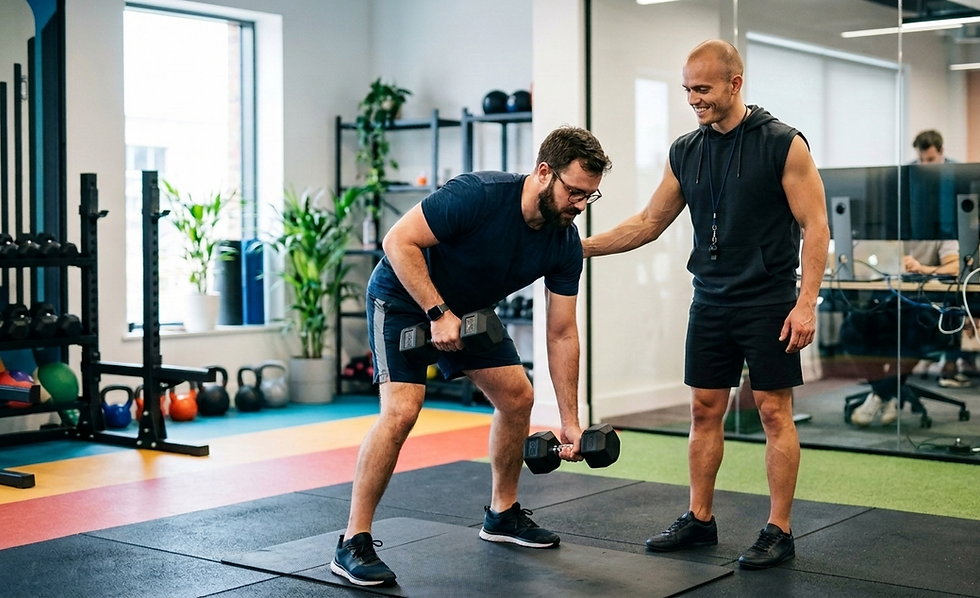
This isn't a performance claim about fitness. It's a claim about nervous system regulation. The developer who trains consistently three times a week isn't just building muscle or losing fat. They're giving their body a reliable mechanism for processing the accumulated stress of a cognitively demanding career in a genuinely uncertain industry.
The Whoop data I look at from my own training shows this directly. On days following good recovery - high HRV, low overnight stress - the after-work feeling is categorically different from days following poor recovery. The same uncertainties exist. The same industry is changing at the same pace. But the physiological capacity to hold that uncertainty without tipping into anxiety is meaningfully different.
This is what physical training actually does for software engineers in the AI era. Not just body composition. Not just energy. The ability to close the laptop and actually be done for the day, because the body has a mechanism for completing the stress cycle that the mind can't complete on its own.
What Doesn't Work
More information doesn't help. Keeping up with every AI development, every industry trend, every think piece about the future of software engineering increases the cognitive load without providing resolution. The uncertainty is structural - it can't be resolved by consuming more of it.
More optimization doesn't help either. The instinct of high-performing engineers facing uncertainty is to systematize, to build better habits, to optimize their way out of the problem. But the after-work anxiety isn't an efficiency problem. It's a nervous system problem. Efficiency tools applied to a dysregulated nervous system make the dysregulation more sophisticated, not less present.
What actually helps is contrast. Physical movement. Low-stimulus recovery. Activities that require the body's attention rather than the mind's. And the consistent practice of returning to physical reality - training, walking, cooking, being outside - as a counterweight to a career that increasingly takes place entirely in the abstract.
The AI era is not going to slow down. The industry is going to keep changing faster than anyone can fully track. The engineers who maintain their capacity to do good work over the long term won't be the ones who consumed the most information or optimized the most aggressively.
They'll be the ones who figured out how to close the laptop and actually rest.
I work 1:1 with software engineers and tech professionals on the specific challenges that come with this career - including the ones that happen after the workday ends. Book a free 30-minute call and let's talk about what's actually getting in the way.


Comments