


Stop Chasing Discipline: A Smarter Fitness Framework for Software Engineers Running on Low Time and Energy
- Alex

- Jun 30
- 6 min read

Most people in tech and especially software engineers who are trying to get healthier think they're fighting a willpower battle.
Wake up earlier.
Eat better.
Push through the tired afternoon instead of giving in to it.
They're fighting the wrong battle.
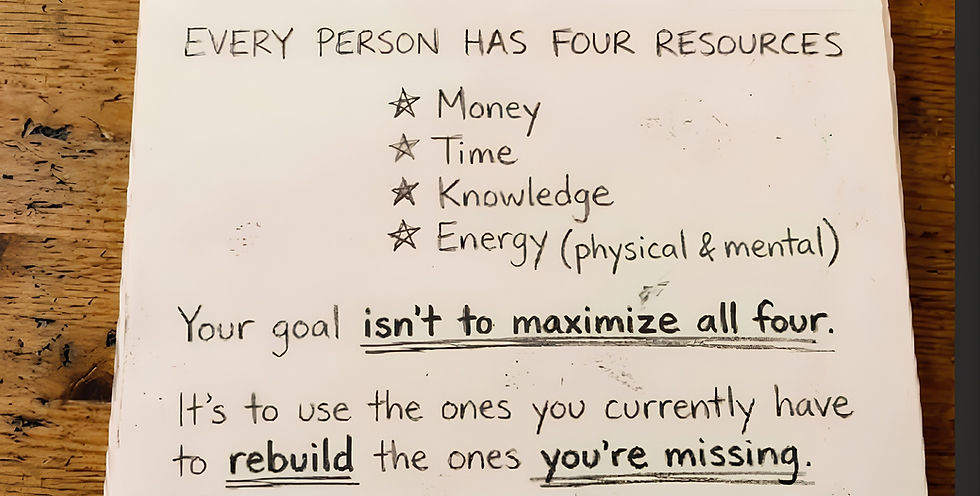
You manage four resources, all the time, in everything you do:
money
time
knowledge
energy
You almost never lack all four simultaneously.
There's usually one or two you have plenty of, and one or two you're starving for.
The fix isn't trying harder with the resource you're missing.
It's spending the ones you have to buy back the ones you don't.
This isn't a fitness concept.
It's how I've approached my entire life, and it's the framework I use with every client before we talk about a single workout or meal plan.
A client example: trading money for time and energy
A client of mine is a software engineer and a new mother. She has money. She has knowledge - she's read enough about nutrition to know what she should be doing. What she doesn't have is time or energy. Between a demanding technical role and a newborn, both are gone before she even thinks about her own meals.
The instinct in fitness coaching is to ask someone like this to "find more discipline" around food. Meal prep on Sunday. Cook every night despite the exhaustion. Push through.
We didn't do that.
We spent the resource she had - money - to buy back the two she didn't.
We found a meal delivery service: 12 prepped meals a week for 97 euros, or 24 for 195. Roughly 8 euros a meal.
This removed grocery shopping, cooking, and the dozens of small food decisions that drain a parent's already-depleted cognitive reserves by evening.
The time saved mattered. But the bigger win was something else entirely - the guilt disappeared.
No more bad food choices to feel bad about. No more pressure to "make up for it" with an extra gym session she didn't have energy for anyway. That mental space went straight back into what she actually wanted: more time present with her family, not more time managing her own failures.
That's not a meal plan. That's resource allocation.
My own story: trading energy and time for knowledge
I lived this principle long before I had language for it.
I was working in Bulgaria for very little money, studying medical college, working night shifts as a security guard, and training - because training was the one constant I refused to give up regardless of what else was missing. I had almost no money and almost no knowledge about how to actually build the life I wanted. What I had, in small amounts, was time on commutes and energy I stubbornly protected through training.
I used that time to read. Books and articles during commutes, mostly about finance - emergency funds, investing, time and money management. A six-month emergency fund was unthinkable for me at that point. But the underlying principle - how to manage time and money deliberately instead of by accident - stuck.
That knowledge is what got me to 250 euros saved and a one-way move to Berlin. Not because I couldn't have saved more. My salary was too low, and what was left after German language courses, my medical education, and saving for the move was almost nothing. I traded years of low energy and long hours for the small amount of knowledge that made the move possible at all.
In Berlin, I arrived with no money and limited knowledge, but I'd recovered some energy and definitely had time. I spent that combination badly at first - more hours in the gym than hours looking for work, until reality forced a correction. Less gym, more job searching, more knowledge-building. The same four resources, rebalanced again.
Energy turned out to be the resource that lifts the other three.
With energy, you have the capacity to learn.
When you learn, you're positioned to earn.
When you earn, you have money and the knowledge to manage your time properly.
It compounds, or it's supposed to.
This cycle - earn energy, spend it on knowledge, convert knowledge to money, use money and knowledge to reclaim time - is how it worked then, and it's how it still works now.
Eight years later: trading money to buy time and proximity
After eight years in Berlin, my wife and I looked at the same four resources again.
This time we had money we hadn't had before. So we spent it - on time. Specifically, on proximity.
We moved to Bulgaria deliberately to buy back time we were losing to distance - distance from family, distance from support raising our daughter, distance from a healthier daily rhythm. Time is money and money is time, and we spent the money side to reclaim the time side.
The result is a life built on five-minute radius.
Ten minutes walking to the gym.
Ten minutes by car to my mother, who watches our daughter while we work from home.
Five minutes to a home-cooked kitchen for lunch, where a full meal costs 3.50 euros and our daughter eats the same food we do.
None of this happened by accident or by finding more discipline.
It happened by identifying which resource was abundant and which was scarce, and deliberately spending one to buy back the other.
Why this matters more than any meal plan or workout split
Most fitness advice assumes everyone has the same starting resources and just needs the right program.
This is why generic advice fails so consistently for software engineers specifically - the resource profile of a senior developer with a newborn is completely different from a junior developer living alone, which is different again from a founder running a company with irregular income but more schedule control.
The question isn't "what's the best workout program." It's "which of my four resources is abundant right now, and which is starving - and what can I spend to fix the imbalance."
If you have money but no time, spending on convenience - meal delivery, a closer gym, even paying for coaching itself instead of trying to figure it out alone - is not weakness. It's the correct trade.
If you have time but no knowledge, that commute, that lunch break, that hour before the house wakes up is where you build the knowledge that eventually buys back money and energy.
If you have energy but no time, that energy is your highest-leverage asset right now, and protecting it - through sleep, through training, through saying no to things that drain it for no return - is what eventually buys you everything else.
Stop asking how to find more discipline for the resource you're missing. Start asking which resource you're already holding that you could spend to buy it back.
Which one are you quietly draining right now, and what are you spending in its place?
I work 1:1 with software engineers and tech professionals on building a fitness and nutrition system around your actual resource profile - not a generic program that assumes you have time and energy you don't. Book a free 30-minute call and let's figure out what you're actually working with.

Frequently Asked Questions
What are the four resources in resource allocation theory?
Money, time, knowledge, and energy. The principle is that you rarely lack all four simultaneously - there's usually one or two you have in abundance and one or two you're missing. Progress comes from spending the abundant resources to buy back the scarce ones, rather than trying to force discipline in the area where you're depleted.
How do I know which resource I'm missing?
Look at where you consistently fail to follow through. If you skip workouts because you're too tired despite having a clear plan, energy is likely your scarce resource. If you know exactly what to do but never have the hours to do it, time is scarce. If you have time and energy but make poor decisions repeatedly, knowledge may be the gap. Money is usually the easiest to identify - it's the resource you'd spend if you had more of it.
Is paying for convenience (like meal delivery or coaching) a sign of weak discipline?
No - it's a resource trade. If you have money and are depleted on time or energy, spending money to buy back time or energy is the efficient allocation, not a shortcut. The discipline framing assumes everyone has equal time and energy, which isn't true for a new parent working full-time versus someone with a flexible schedule and no dependents.
Can this framework apply to nutrition and training specifically?
Yes, directly. A client with money but no time and energy benefits more from meal delivery and a minimal, efficient training program than from an elaborate meal-prep routine and high-volume training split she'll never sustain. The program needs to match the actual resource profile of the person, not an idealized version of their week.
What if I'm low on all four resources?
This is rare in practice, but when it happens, the smallest possible intervention in the resource that's least depleted is the place to start - even if it's marginal. For most people, energy is the resource that compounds into the others over time, so protecting sleep and basic physical recovery, even in a depleted state, tends to be the highest-leverage starting point.



Comments