


The Software Engineer's Workout Routine: How to Build Muscle and Lose Fat with 2 Hours a Week
- Alex

- May 11
- 6 min read
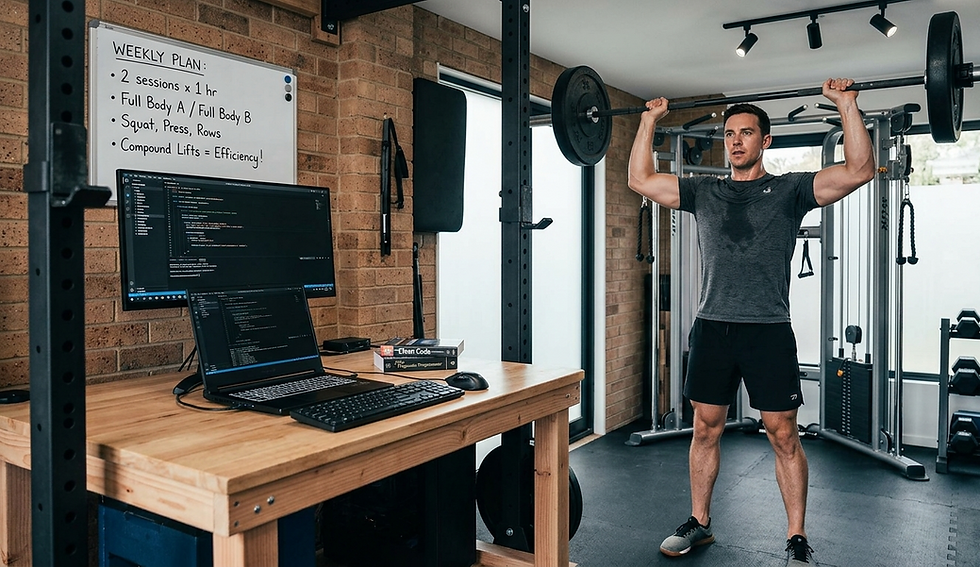
Most workout routines are not designed for software engineers.
They're designed for people with predictable schedules, consistent energy levels, and a life that doesn't involve two-week sprint cycles, production incidents at 11pm, or the kind of cognitive load that leaves you genuinely depleted by 6pm.
The result is that most software engineers either follow a program built for someone else - and burn out - or do nothing at all, waiting for a less busy season that never arrives.
This post gives you something different: a workout structure built specifically around the way software engineering actually works.
Two hours a week.
No gym required.
Designed to build muscle, lose fat, and - critically - make you think more clearly.
Why "Think More Clearly" Is the Right Metric

Most fitness content targets how you look.
That's a legitimate goal - but it's a slow feedback loop.
Visible body composition changes take months.
There's a faster feedback loop that software engineers respond to immediately: cognitive performance.
Exercise - specifically resistance training - has well-documented effects on the brain.
Improved working memory.
Faster processing speed.
Better stress regulation.
Reduced decision fatigue in the hours after training.
Sharper focus during deep work.
For a software engineer, these are not abstract benefits.
They're competitive advantages.
The engineer who trains consistently doesn't just look better over time.
They debug faster, make better architectural decisions, handle pressure more calmly, and have energy left at 7pm for the people they care about.
When you start measuring your training by how your brain performs - not just how your body looks - consistency becomes much easier to maintain. The feedback is immediate and directly relevant to your work.
The Sprint Periodization Mode

Here's the concept that makes this routine different from everything else you've tried:
Train according to your work cycle, not against it.
Software engineers work in cycles - sprints, releases, deadlines, quiet periods.
Most workout programs ignore this entirely and demand the same output every week regardless of what's happening professionally.
This is why programs fail during crunch periods. The program demands full effort, life doesn't allow it, you miss sessions, feel guilty, and quit.
The sprint periodization model works differently:
Heavy sprint weeks (high work pressure): Shorter sessions, lower volume, higher rest periods. The goal is maintenance - keep the habit alive, keep the stimulus present, don't add physical stress to an already-stressed system. 20-25 minutes per session.
Light sprint weeks (lower work pressure): Full sessions, progressive overload, push the weights. This is when adaptation happens. 35-40 minutes per session.
You're not always training at maximum.
You're training intelligently relative to your total stress load - exactly the way a good engineer manages system resources.
This model means you never fully stop, even during the most demanding periods. And it means you capitalize on quieter weeks to actually make progress.
The Actual Routine
Two sessions per week. Full body each time. No gym required - bodyweight plus resistance bands or a set of dumbbells covers everything.
The sessions are labeled A and B. Alternate them each week.
Session A - Push & Hinge Focus
Duration: 28-35 minutes
Warm-up - 3 minutes
30 seconds arm circles
30 seconds leg swings
60 seconds bodyweight squats (slow tempo)
60 seconds hip hinges
Main Work - 4 exercises, 3 sets each
1. Push-up variation - 3 sets × 8-12 reps, 90 seconds rest (Progression: standard → archer → feet elevated → weighted)
2. Romanian Deadlift — 3 sets × 10 reps, 90 seconds rest (Dumbbells or resistance bands. Slow eccentric - 3 seconds down)
3. Dumbbell Shoulder Press — 3 sets × 10 reps, 90 seconds rest (Seated or standing. Control the movement - no momentum)
4. Glute Bridge - 3 sets × 12 reps, 60 seconds rest (Add a dumbbell on hips for progression. Squeeze at the top for 2 seconds)
Core Finisher - 5 minutes
Plank: 3 × 30-45 seconds
Dead bug: 3 × 8 reps per side
Session B — Pull & Squat Focus
Duration: 28-35 minutes
Warm-up - 3 minutes
30 seconds thoracic rotations
30 seconds world's greatest stretch per side
60 seconds band pull-aparts (or towel pulls)
60 seconds bodyweight lunges
Main Work - 4 exercises, 3 sets each
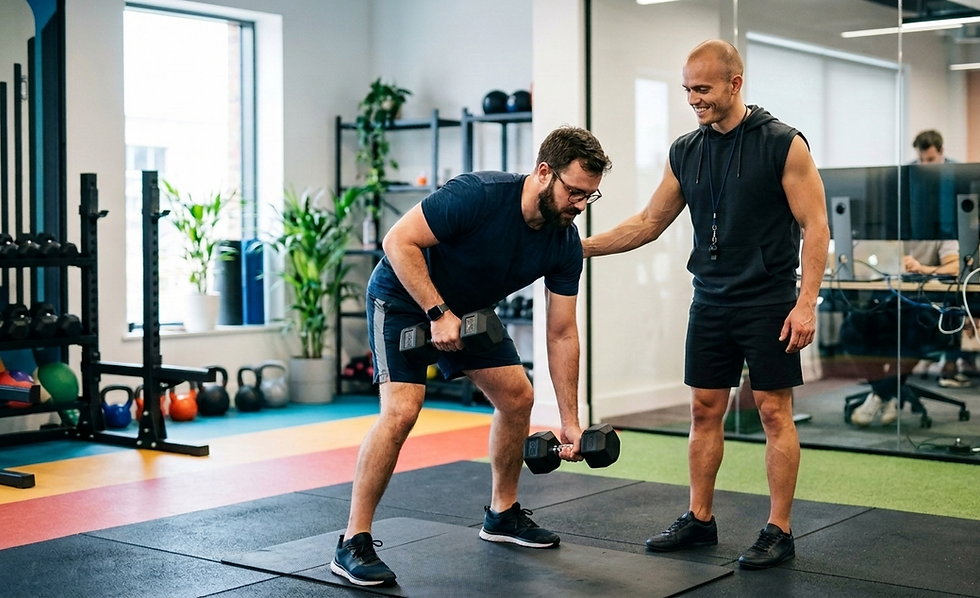
1. Dumbbell Row or Band Row - 3 sets × 10 reps per side, 90 seconds rest (Brace the core. Pull the elbow back, not the hand up)
2. Goblet Squat - 3 sets × 10 reps, 90 seconds rest (Dumbbell or kettlebell held at chest. Sit into the squat - don't just bend the knees)
3. Face Pull or Band Pull-Apart - 3 sets × 15 reps, 60 seconds rest (Crucial for posture correction from desk work. Don't skip this)
4. Reverse Lunge - 3 sets × 8 reps per side, 90 seconds rest (Step back, not forward. More controlled, less knee stress)
Core Finisher - 5 minutes
Side plank: 3 × 20-30 seconds per side
Hollow body hold: 3 × 20 seconds
How to Progress
Progressive overload is what separates training from just moving. Without it, you maintain - you don't build.
The rule is simple: when you can complete all reps of all sets with good form and two reps still in the tank - add load or difficulty next session.
For bodyweight exercises: progress to a harder variation. For weighted exercises: add 2.5kg (or the smallest increment available).
Do not add load and reduce form. Form first, load second. Always.
Track your sessions - even just in the Notes app on your phone.
Weight used, reps completed.
This takes 2 minutes and is the difference between progressing and spinning your wheels.
The Weekly Structure

Option 1 - Monday / Thursday Recovery day between sessions. Weekend fully free.
Option 2 - Tuesday / Friday Same logic. Works well if Monday mornings are consistently chaotic.
Option 3 - Flexible (sprint periodization) During heavy sprint weeks: whenever two gaps of 30 minutes appear. Don't let more than 4 days pass between sessions.
The days don't matter as much as the consistency. Two sessions per week, every week, is the non-negotiable.
Nutrition: The Minimum That Moves the Needle

The routine without nutrition is a car without fuel. But this doesn't need to be complicated.
Two numbers matter:
Protein: 1.6-2g per kg of bodyweight per day. For a 85kg engineer, that's 136-170g. Most tech professionals are hitting 60-80g. Close this gap first - before worrying about anything else.
Total calories: Don't aggressively restrict while training. Your brain needs fuel. Eat enough to support cognitive performance during the day. If fat loss is the goal, a modest deficit of 200-300 calories below maintenance is sustainable. More than that while managing a demanding job leads to the energy crashes and decision fatigue that kill both work performance and dietary adherence.
Practical protein sources that require zero cooking skill:
Greek yogurt (15-20g per serving)
Cottage cheese (14g per 100g)
Protein shake (25-30g, takes 60 seconds)
Eggs (6g each - have more of them)
Chicken breast or canned tuna (25-30g per 100g)
What to Expect and When
Weeks 1-3: The sessions feel unfamiliar. Focus entirely on form, not weight. This is the most important phase - building the movement patterns that make everything else possible.
Weeks 4-8: The routine becomes automatic. You stop thinking about whether to do it and just do it. First visible changes in how clothes fit. Energy and focus improvements are noticeable to you even if invisible to others.
Months 3-6: Progressive overload is producing real strength gains. Body composition is measurably different. Colleagues start commenting. More importantly - your cognitive performance at work has shifted in ways you can feel.
6-12 months: A fundamentally different baseline. Not from a dramatic transformation - from consistent application of a simple system over a long enough time horizon.
This is how compounding works in fitness.
The same way it works in software, in investing, in everything that matters.
The One Commitment Required
Not motivation. Not perfect nutrition. Not a gym membership.
One commitment: two sessions per week, every week, for the next 12 weeks.
Not perfect sessions. Not sessions where you feel like it. Just sessions that happen.
After 12 weeks, look at the data - your strength numbers, your energy, your cognitive performance, how your clothes fit. Make a decision then.
But give the system 12 weeks before evaluating it. That's one sprint cycle longer than most people give anything before quitting.
I work 1:1 online with software engineers, tech leads, founders, and high-performing professionals who want a fitness system built around their actual life - not someone else's. If you want this routine personalised to your schedule, your equipment, and your specific goals - book a free 30-minute call. No pitch. Just a plan.


Comments