


From Berlin to a Village in the Rhodope Mountains: What 8 Years in a Big City Taught Me About Fitness, Risk, and Building a Life That Actually Fits
- Alex

- 2 days ago
- 6 min read
Updated: 24 hours ago

Not as a romantic adventure. As a necessity. I had just finished medical college in Bulgaria - qualified as a radiologic technologist. I am working since I was 17. I paid for my own education. I knew what it meant to start from nothing before I had a word for it.
For a year and a half, I lived in a student dorm designed for one person - with my then-girlfriend, now wife. No legal status. Cash-in-hand work for 7 euros an hour. German classes in whatever time was left. Failed B2 three times. Passed on the fourth.
Then I walked into Charite Benjamin Franklin hospital with broken German and unrecognised Bulgarian qualifications and asked for a job.
They hired me.
Year and a half later I decided to quit and finally start my journey as a personal trainer in Berlin.
Three months later, every gym in the world closed.
COVID.
I had already spent money on Google ads. I had clients lined up. I had no income and no fallback.
So I launched training sessions from the living room of our Berlin apartment. For almost a year, that was my gym. A laptop, a camera, clients on a screen, me coaching in a space roughly four meters wide.
It was not the ideal environment to start a fitness business.
It also taught me more about coaching than any gym ever did.
Eight Years in Berlin. Then a Different Question.
By the end of eight years in Berlin, we had built something real. Stable income. A routine. A city that had given us a lot.
But the city had started taking more than it gave.
That constant low-level exhaustion that doesn't go away on weekends.
The feeling of being permanently in motion without going anywhere that actually mattered.
The apartment with no balcony, windows you couldn't open because of the noise, an ambulance or police siren every hour.
We started asking a different question: not "how do we optimise life in Berlin" but "what kind of life do we actually want?"
The answer pointed somewhere unexpected.
300 People. No Gym. No Guarantees.

In January 2023, my wife and I left Berlin and moved to a village in the Rhodope mountains in Bulgaria.
We had never been there. We knew no one in the village. We found the house through a Facebook group for weekend rentals - negotiated a year-long lease from a landlord who normally rented to tourists for three nights at a time.
300 people live there. Or so we were told.
Our parents told us we were crazy. Too romantic. Too optimistic. What happens when it snows and you can't leave? What happens if there's no electricity?
Both of those things happened. We figured it out.
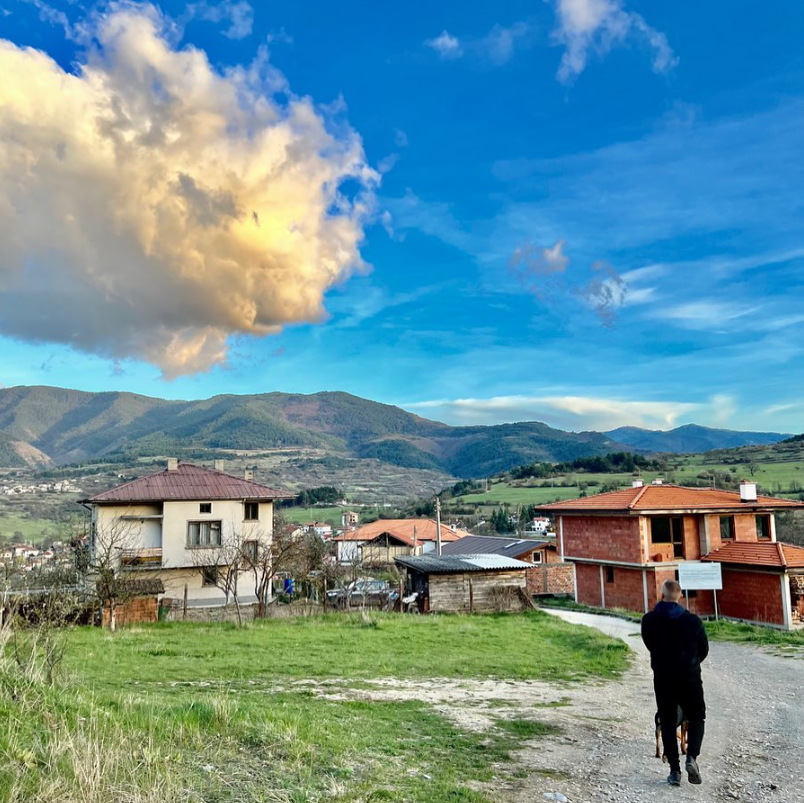
What we didn't figure out in advance - and couldn't have - was how much the environment would change everything. Not the problems. The problems followed us from Berlin exactly as expected. Financial uncertainty. Business pressure. Clients getting laid off from big tech companies, which affected our income immediately.
The problems were the same. But the capacity to deal with them was different.
The Home Gym
One of the first things we did when we arrived was convert a bedroom into a gym.
2,600 euros for the full setup - barbell, plates, bench, rack. Mid-range equipment. Not glamorous. Completely functional.
It was, genuinely, one of the first times in my life I had exactly what I needed to train the way I wanted to train - no commute, no waiting for equipment, no gym floor politics. Just the basics, done well, consistently.
And training here, in a mountain village, with fresh air and actual nature outside - it clarified something I had understood intellectually for years but now understood physically:
The environment you train in is not separate from the results you get. Sleep quality, stress levels, recovery capacity, the ability to actually show up - all of it is connected. All of it matters.
The software engineers and tech professionals I work with are living the Berlin version of this. Performing at high levels in environments that are slowly depleting them.
Training inconsistently because the conditions are never quite right. Waiting for a better season of life to start taking their physical health seriously.
That season doesn't arrive on its own. You have to choose it.
What the Village Taught Me About Coaching
When you remove the gym environment entirely - the equipment, the atmosphere, the social accountability of showing up somewhere - what's left is the actual coaching.
Does the client understand why they're doing what they're doing? Can they execute a program independently? Do they have enough internal motivation to show up without external structure?
Online coaching, done correctly, builds the internal system. The client learns to train independently, understands the principles behind the program, and develops the habit as their own rather than as a response to someone else's presence.
This is not a compromise on in-person training. For tech professionals, entrepreneurs, and anyone with a demanding career - it is a better model.
The scheduling constraint disappears. The commute disappears.
The barrier to starting a session drops to almost zero. And because the coaching is built around understanding rather than presence, it continues to work when life gets complicated - which, for the people I work with, is most of the time.
The Things That Don't Change
Here's what I know after moving to Berlin with 250 euros, working cash jobs for 7 euros an hour, launching a fitness business three months before a global lockdown, and then leaving a stable life in a major city for a village in the Rhodope mountains:
Problems don't disappear when the environment changes.
They follow you.
The uncertainty follows you.
The financial pressure follows you.
The hard nights follow you.
What changes is your capacity to deal with them.
Physical health is not separate from this capacity. It is the foundation of it. The quality of your sleep, your energy under pressure, your ability to think clearly after a difficult day, your patience with the people you care about - all of it sits on top of how well you're taking care of your body.
This is not a motivational statement. It's something I've watched play out in my own life and in the lives of the people I work with - software engineers, entrepreneurs, team leads, remote workers - people who are performing at high levels professionally and running a slow, invisible deficit physically.
The deficit compounds. So does the investment.
What I Actually Do
I work 1:1 online with tech professionals, software engineers, entrepreneurs, and high-performing people who want to build physical health that fits their actual life.
One check-in call per month. A training program in an app on your phone. Nutrition guidance built around your existing patterns - not a meal plan you'll abandon in two weeks. Async communication between calls.
No gym required. No fixed location. No program designed for someone with more time, more energy, and fewer responsibilities than you actually have.
The entire model is built around the insight I picked up coaching from a four-meter-wide living room during a global pandemic: the environment doesn't have to be ideal. The system just has to work within the environment you have.
Why Any of This Matters
I'm telling you this not because the story is interesting - though I think it is - but because the people I work with are often waiting for something.
Waiting for a less busy quarter.
Waiting until the product launches.
Waiting until life settles down.
I moved to a new country with 250 euros and no legal status. I launched a business three months before a global lockdown. I left a stable life in Berlin for a village where I knew no one and had never set foot.
None of those were ideal conditions.
All of them were the actual conditions.
You already have everything you need to start.
If you're a software engineer, entrepreneur, or tech professional who's ready to build fitness that fits your actual life - not a theoretical one - book a free 30-minute call. No pitch. Just a conversation about where you are and what would actually work.


Comments