


How to Build Muscle Working From Home as a Software Engineer
- Alex

- May 12
- 7 min read
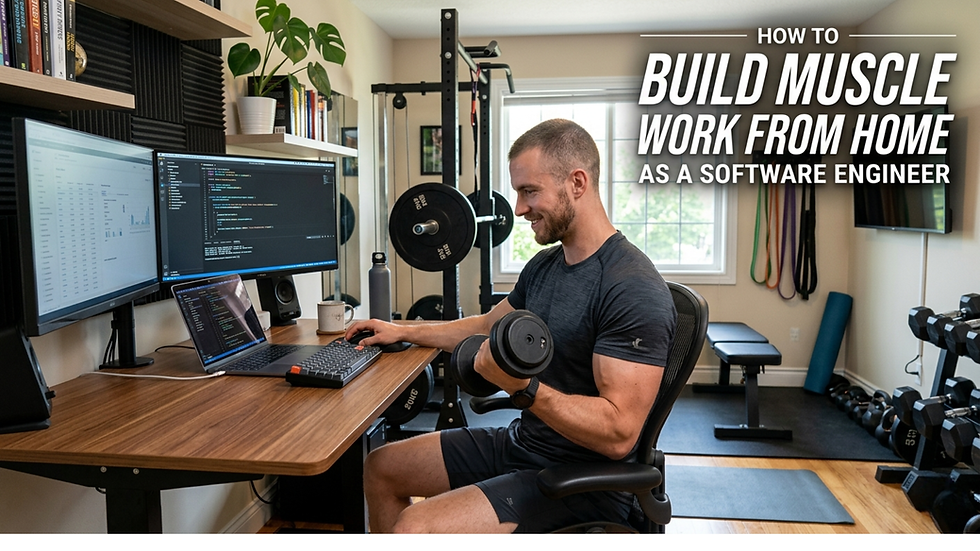
Most muscle-building advice assumes you have three things: a gym membership, 5 free hours per week, and a body that isn't already exhausted from 10 hours of deep focus work.
If you're a software engineer working remotely, you have none of these.
What you do have is something most fitness content ignores entirely: a home, consistency in your schedule, and a brain that responds well to systems.
This post gives you a complete framework for building real muscle as a remote software engineer - without a gym, without hours of free time, and without a program designed for someone living a completely different life.
Why Remote Work Is Actually an Advantage for Building Muscle as a Software Engineer
Before getting into the how, let's address the assumption most remote engineers make: that working from home makes fitness harder.
It doesn't. It makes it different.
In-person office work means commuting, unpredictable schedules, lunch meetings, after-work drinks, and a gym that requires a separate trip.
Remote work means your training environment is 10 meters from your desk.
The barrier to starting a session is almost zero.
The engineers who fail at home training aren't failing because of the environment. They're failing because they're using the wrong program - one built for someone with different constraints - or because they have no program at all.
The remote software engineer who builds a system around their actual life will consistently outperform the office engineer who "tries to get to the gym when possible."
Systems beat intentions. Every time.
The Muscle-Building Fundamentals That Don't Change

Before the home-specific advice, the non-negotiables - because these apply regardless of where you train.
Progressive overload is everything.
Muscle grows when you consistently ask it to do more than it did before. More weight, more reps, more sets, harder variations. Without progressive overload, you're maintaining at best.
This is the single most important concept in resistance training. Everything else is detail.
Protein is non-negotiable.
Muscle is built from protein. Without adequate protein, your training stimulus produces minimal adaptation. The target for muscle building is 1.8-2.2g of protein per kilogram of bodyweight per day.
For a 80kg software engineer, that's 144-176g daily. Most remote engineers eating convenience food and skipping meals are hitting 60-80g. This gap explains a significant portion of why training "isn't working."
Recovery is where the muscle is built.
Training is the stimulus. Recovery - sleep, rest days, adequate calories - is where the actual adaptation happens. A remote engineer who sleeps 6 hours, trains hard, and under-eats is not building muscle. They're accumulating fatigue.
Sleep is not optional. It's a core part of the program.
What Equipment You Actually Need
The barrier most remote engineers cite is equipment. The reality is that you need far less than you think.
Minimum setup (around 100-150 euros one-time):
A set of resistance bands (light, medium, heavy)
A pull-up bar that fits a doorframe
A pair of adjustable dumbbells or two fixed pairs
This covers the vast majority of movement patterns - push, pull, hinge, squat, carry. The limiting factor is rarely equipment. It's consistency and progressive overload.
Ideal setup (adds 200-300 euros):
Adjustable dumbbell set (5-30kg range)
A bench or sturdy chair substitute
A set of heavier resistance bands
With this setup, you can train effectively for years without ever needing a gym.
The Remote Engineer's Muscle-Building Program
Two sessions per week. Full body each session. 35-45 minutes.
The sessions are structured around the fundamental movement patterns - push, pull, hinge, squat, carry - because hitting every pattern twice per week is the most efficient route to full-body muscle development for someone with limited training time.
Session A
Warm-up - 4 minutes
60 seconds arm circles and shoulder rolls (desk posture reset)
60 seconds hip circles
60 seconds bodyweight squats, slow tempo
60 seconds band pull-aparts
Main Work
1. Push-up variation - 4 sets x 8-10 reps, 90 seconds rest Progression ladder: standard - archer - feet elevated - weighted vest or backpack The slow eccentric matters here - 3 seconds down, explosive up.
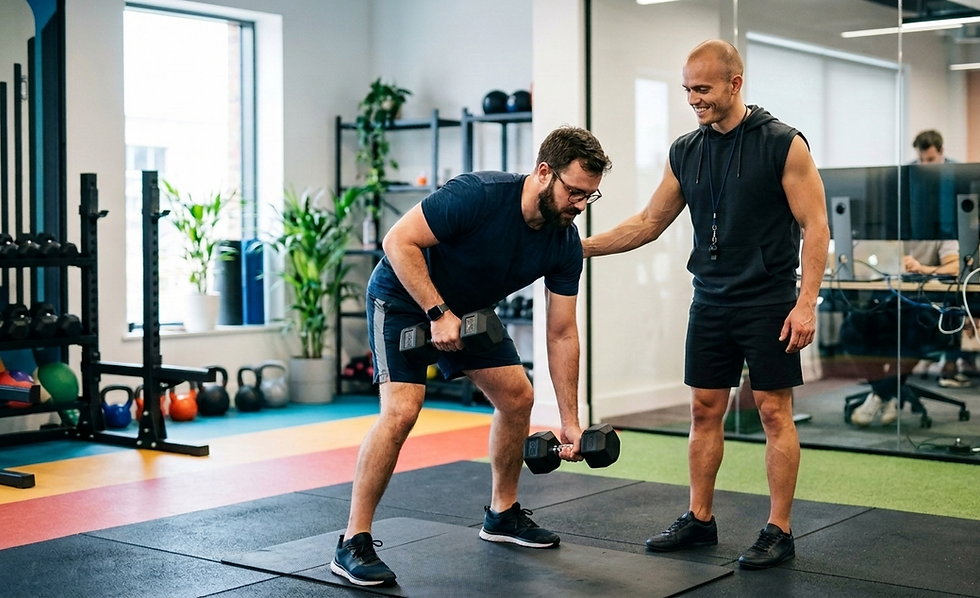
2. Dumbbell Romanian Deadlift - 4 sets x 10 reps, 90 seconds rest Hinge at the hips, not the waist. Feel the hamstrings load. Control the descent.
3. Dumbbell Shoulder Press - 3 sets x 10-12 reps, 90 seconds rest Seated or standing. No momentum - controlled press and controlled descent.
4. Band Pull-Apart - 3 sets x 15 reps, 60 seconds rest Non-negotiable for remote engineers. Counteracts the forward shoulder position from hours at a desk.
5. Dumbbell Curl - 3 sets x 12 reps, 60 seconds rest Slow eccentric - 3 seconds down. This is where the growth stimulus is.
Core - 5 minutes
Plank: 3 x 40 seconds
Dead bug: 3 x 8 reps per side
Session B
Warm-up - 4 minutes
60 seconds thoracic rotations
60 seconds world's greatest stretch per side
60 seconds band rows
60 seconds reverse lunges
Main Work
1. Pull-up or Band-Assisted Pull-up - 4 sets x max reps (aim for 5-8), 2 minutes rest If you can't do pull-ups yet: band-assisted pull-ups or dumbbell rows as substitute. If you can do 10+ easily: add weight via backpack.
2. Goblet Squat - 4 sets x 10-12 reps, 90 seconds rest Dumbbell held at chest. Sit into the squat - don't just bend the knees. Full depth.
3. Dumbbell Row - 3 sets x 10 reps per side, 90 seconds rest Brace the core hard. Pull the elbow back, not the hand up. Pause at the top.
4. Reverse Lunge - 3 sets x 8 reps per side, 90 seconds rest Step back, not forward. More knee-friendly. Control the descent.
5. Tricep Dips or Band Tricep Pushdown - 3 sets x 12 reps, 60 seconds rest Use a chair or the edge of a desk for dips. Full extension at the bottom.
Core - 5 minutes
Side plank: 3 x 25 seconds per side
Hollow body hold: 3 x 20 seconds
How to Progress Without a Gym
Progressive overload at home requires slightly more creativity than in a gym, but it's straightforward once you have the framework.
The progression ladder:
Week 1-2: Master the form. Don't worry about load.
Week 3-4: When you can complete all reps with good form and two reps still available - add load or difficulty.
For bodyweight exercises: move to the next variation on the progression ladder. For dumbbell exercises: increase weight by the smallest increment available. For band exercises: move to the next resistance band or add a second band.
Track every session. Seriously. Even just in the Notes app - exercise, weight, reps. Without tracking, you're guessing whether you're progressing. With tracking, you have data. Engineers work with data.
Nutrition for Muscle Building as a Remote Engineer

The remote work environment creates specific nutritional challenges that office work doesn't.
The proximity problem. Your kitchen is 10 meters away all day. This is both an advantage and a risk. Convenient access to food means convenient access to poor choices when cognitive load is high.
The meal-skipping problem. Deep focus sessions mean some remote engineers skip meals entirely, then overeat in the evening. This is incompatible with muscle building, which requires consistent protein distribution across the day.
The solution - three anchors:
Anchor 1 - High protein breakfast. 3-4 eggs, Greek yogurt, cottage cheese, or a protein shake. 30-40g of protein before you open your laptop. Non-negotiable.
Anchor 2 - Structured lunch. Not whatever is convenient. A meal with a protein source - chicken, fish, eggs, legumes - plus vegetables. Prepare it the night before if decision fatigue during the day makes this hard.
Anchor 3 - Post-session protein. After each training session, consume 25-40g of protein within 2 hours. Protein shake is fine. This is the most impactful nutritional timing decision for muscle building.
Everything else - snacks, dinner, weekend eating - is secondary to getting these three anchors right consistently.
Fitting Training Into a Remote Work Day
The remote schedule creates natural windows that office work doesn't.
The pre-work window (6:30-8:00am): Before the laptop opens, before Slack notifications, before cognitive load begins. Many remote engineers find this the most reliable window because nothing can interrupt it.
The lunch window (12:00-13:30): A 35-minute session followed by a shower and lunch fits within a standard lunch break. No commute required.
The between-meetings window: Remote work often has gaps between calls that office work doesn't. A 35-minute session fits in a 45-minute gap. This requires flexibility but is available more often than most engineers realize.
The specific window matters less than the consistency. Pick one that works for your current schedule and protect it with the same energy you'd protect a critical deployment window.
What to Expect and When
Month 1: The movements feel unfamiliar. Focus entirely on technique. Expect some muscle soreness. No visible changes yet - you're building the neurological foundation that makes everything else possible.
Month 2-3: The sessions become automatic. Progressive overload starts producing real strength gains. First visible changes in upper body - shoulders, arms, upper back. Energy during work hours improves noticeably.
Month 4-6: Meaningful body composition changes visible to others. Strength numbers are significantly higher than month 1. The habit is fully embedded - missing a session feels wrong, not normal.
Month 6-12: A fundamentally different physical baseline. Remote work colleagues notice on video calls. More importantly - the cognitive benefits are compounding. Better focus, lower afternoon energy crashes, more consistent mood.
Building muscle as a remote engineer is slower than gym culture suggests and faster than most remote engineers expect when they have the right system.
The One Thing That Determines Everything
Not the program. Not the equipment. Not the nutrition.
Consistency over 6-12 months.
The remote engineer who trains twice a week, every week, for a year - even imperfectly, even with modest equipment, even with an occasionally disrupted schedule - will build more muscle than the one who waits for the perfect setup, the perfect program, and the perfect season of life.
You already have everything you need to start.
The laptop can wait 35 minutes.
I work 1:1 online with software engineers, remote developers, and tech professionals who want to build muscle and lose fat without a gym - designed around the actual constraints of a remote career. Book a free 30-minute call and let's build a program around your specific setup, schedule, and goals.


Comments